

The 10 Essential Monuments of Úbeda: decalogue for souls looking for beauty without apologies
24/10/2025
Pay attention, demanding travellers who are not satisfied with hasty selfies: Úbeda is not a city to be crossed in…

There are cities that accelerate and cities that invite you to stop. Úbeda clearly belongs to the second group. Its leisurely pace, its stone spaces bathed in a particular light, the silence that inhabits its courtyards and squares make it the perfect setting for one of the most pleasurable and increasingly rare activities: reading without haste, without interruptions, letting yourself be carried away by the pages while time dissolves.
If you are one of those who travel with books in your suitcase, those who are looking for a sunny bench to get lost in a novel or you need that time of day where the world is reduced to you and a few printed words, this article is your map. Here are the best places in Úbeda to read, and also some suggestions on which books connect especially well with the spirit of this city.
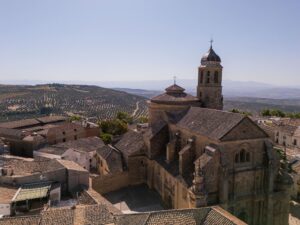
Let’s start with the most iconic place. Not only is Plaza Vázquez de Molina one of the most beautiful Renaissance squares in Europe, it’s also a surprisingly quiet space considering its monumental significance.
Choose one of the benches that surround the square, preferably on the side where the sun shines on winter mornings (the flank of the Sacred Chapel of the Savior), and open your book. Around you, sixteenth-century palaces. In front of you, the Plateresque façade of the chapel with its profusion of sculptures. The silence was only broken by the water of the central fountain and, from time to time, the passage of a tourist.
Reading here has something of a ceremony. It is as if architecture demands to be at its level, and a good book in your hands is the best way to honor it. It works especially well with historical novels, with essays on art or with poetry. Something that dialogues with the greatness of the environment without being crushed by it.
What to read here: The Heretic by Miguel Delibes, set in the sixteenth century. Or the poetry of St. John of the Cross, who lived and died in this city. Anything by Antonio Muñoz Molina also works, his prose mentions the Magina and has that tempo of Andalusian cities where time flows differently. Also writers such as David Ucles or Joaquín Sabina.
Best time: Mid-morning in winter, when the sun warms the stones. Or late afternoon in spring, when the light turns golden.
The Hospital de Santiago has back gardens that few people visit. They are small, without great scenic displays, but precisely for that reason they work perfect for reading. There are benches under the trees, flower beds according to the season and absolute peace.
This is the perfect corner for long readings, for those 500-page novels that require sustained concentration. No one is going to interrupt you, there is no noise of cars, hardly any people pass by. You can be there for an hour or three without realizing that the world is still turning on the other side of the walls.
In winter, if it’s cold, you can opt for the hospital’s interior cloisters. Walk among the columns with a book in your hand, sit on any bench and let yourself be enveloped by the architecture. There is something in the geometric regularity of the Renaissance cloisters that favors concentration.
What to read here: The great nineteenth-century novels that require time and attention. Les Misérables, Anna Karenina, Middlemarch. Or those dense and complex contemporary novels that are so enjoyable when you can immerse yourself without interruptions.
Best time: Any time is good. The gardens are almost always empty. If you are looking for maximum solitude, go early in the morning or late in the afternoon.
Sometimes visual amplitude is needed to accompany the reading. The Mirador de las Eras del Alcázar offers panoramic views over the Guadalquivir valley and the infinite sea of olive trees that characterise the region. There is a small space with benches where you can settle down with your book and, between paragraphs, look up and let your gaze get lost in the horizon.
Reading here is especially recommended if your book has to do with landscapes, with nature, with that relationship between human beings and the territory. Views help connect with certain texts in a way that you wouldn’t get in an enclosed space.
It is also perfect for poetic or contemplative readings. Short texts that are read between long pauses, which invite us to look outwards as well as inwards.
What to read here: Everything that has to do with olive trees and oil. Patrick Süskind’s sympathetic ink includes beautiful passages about olive trees. Or the poetry of Antonio Machado, although he wrote about fields in Castile, his view of the landscape fits perfectly with these Andalusian views. Also nature essays such as those of Robert Macfarlane.
Best moment: Sunset, without a doubt. The light over the olive trees is spectacular and the silence deepens when evening falls.
The Municipal Library of Úbeda, located in the Hospital de Santiago, is a beautiful space. Its reading room occupies one of the old rooms of the hospital, with high ceilings, wooden furniture and that atmosphere of concentration and respect that characterizes good libraries.
Here you can read your own books or explore the library’s collection, which includes interesting sections on local history, Andalusian literature and a well-stocked collection of classics. There is also free Wi-Fi, in case you need to check something online or simply let someone know that you are going to be offline for a couple of hours.
The best thing about libraries is that they’re designed for reading. The tables are the right height, the light is good, silence is guaranteed, and sharing space with other readers creates a kind of silent community that facilitates concentration.
What to read here: What you need to study or consult. Dense essays, academic books, readings that require note-taking. It’s also a good place to discover local authors or books about Ubeda history that you wouldn’t easily find outside of here.
Best time: In the morning, when it has just opened and there are few people. Or weekday afternoons, equally quiet.
The charming little squares of the historic centre
If you are lucky enough to be in them, take advantage of them to read. The combination of open but protected space, the presence of water (almost all of them have a fountain), the plants, the filtered light… Everything contributes to creating a perfect atmosphere for introspective reading.
The squares invite intimate readings. Diaries, memoirs, letters, confessions. Also to those books that they reread over and over again, that always accompany you and that you open knowing exactly what they are going to give you.
What to read here: Paul Auster’s Invention of Solitude. The Confessions of St. Augustine (very appropriate in a city with such a spiritual charge). The diaries of Virginia Woolf. Or anything by Clarice Lispector, whose writing has that quality of intimate penetration that connects perfectly with the atmosphere of the courtyards.
Best time: Mid-morning, when the light comes in but it’s not too hot yet. Or the cool spring afternoons.
At the southeastern end of the historic center there is an area known as Redonda de los Miradores. It is less visited than other tourist spots, precisely because it is somewhat secluded, but that makes it perfect for those looking for absolute solitude.
There are scattered banks from where you can see the valley and, beyond, the silhouette of the Sierra de Cazorla. It is a place to read books that talk about travel, exploration, searches. Texts that need that open horizon as a counterpoint.
It also works great for philosophical or spiritual readings. Something in the combination of height, perspective and silence invites big thoughts, those readings that make you rethink how you see the world.
What to read here: The classics of the journey: On Kerouac’s road (although only to contrast: his frenetic America with this immobile Úbeda). Letters from my cell in Bécquer. Montaigne’s Essays. Or Thoreau’s Walden, with his meditation on simple living and contemplation.
Best time: Late, when most tourists have already left and the city recovers its local rhythm.
If you want to read in a less monumental and more everyday environment, the Plaza del Primero de Mayo is your place. Here the neighbors of the neighborhood meet, there are a couple of bars with their terraces, children play, grandparents chatting on the benches… It’s neighborhood life, authentic and without pose.
Reading here is reading accompanied without feeling observed. You are part of the urban landscape, one more element of the square. And there is something very beautiful about sharing public space with the inhabitants of the place, in being one more reader among so many others who use the square for their things.
It is a good place for light reading, for those novels that are left and resumed, for books of short stories or essays that you can read in parts. Also for readings in languages you are studying, where interruptions are not so annoying.
What to read here: Costumbrista novels, neighborhood stories. All Almudena Grandes works well. Also the stories of Alice Munro, with her look at ordinary lives. Or simply the newspaper, which in a neighborhood square is an institution.
Best time: Mid-afternoon, when the square is livelier but without stress. Or Sunday mornings, which have that relaxed weekend feel.
One of the joys of Úbeda is that it is full of corners that do not appear in the guidebooks. Alleys that lead to small squares with a bench and a fountain. Stairs with a little sun that invite you to sit down.
Explore the historic center aimlessly and when you find a place that calls you, stop. Try taking out the book and staying for a while. If it works, you have gained a reading corner that is yours alone, that no other traveler knows, that you will be able to claim on future visits.
These anonymous spaces, without monumental charge, without expectations, are often the best for reading. There’s nothing that should impress you, nothing to look at except the pages of your book. The city becomes a simple protective wrapping for your reading.
What to read here: Whatever you are reading at that moment. The book you took with you for the trip, the one that accompanies you and that doesn’t have to have any special relationship with Úbeda. Sometimes the best book-place pairing is the one that arises spontaneously, without planning.
Although this article focuses on outdoor or monumental spaces, it would be unfair not to mention some cafes in Úbeda that respect the reader.
Look for traditional bars and cafes, those that flee from the Starbucks concept and maintain their local identity. Places with individual marble tables, cane chairs, newspapers available and waiters who don’t look down on you if you stay for two hours with just one coffee.
These spaces have something of an urban refuge. You can read while watching life go by, order another coffee whenever you feel like it, take a break for a snack and return to the book. It is a more social form of reading, less solitary, but equally concentrated.
What to read here: Crime novel, perfect with coffee. Philip Roth, whose writing has that edgy rhythm that gets along well with the cafeteria atmosphere. Stories by Chekhov or Carver, short stories that you can read in coffee time.
Best time: Mid-morning or mid-afternoon, when coffee shops are quiet between peaks in demand.
Beyond the corners, it is worth talking about what kind of readings are particularly well in tune with the spirit of this city.
Mystical poetry: Úbeda was the place where St. John of the Cross died in 1591. Reading his poetry here, especially in religious or contemplative spaces, adds layers of meaning. Dark Night of the Soul, Spiritual Canticle… They are texts that are illuminated in a different way when you read them in the place where they were written or where their author lived his last days.
Historical novel of the Golden Age: Everything set in the sixteenth-seventeenth centuries takes on a special life in Úbeda. Arturo Pérez-Reverte’s novels such as Captain Alatriste (the film was filmed in Úbeda!), although they take place in Madrid and Flanders, they breathe the same air of the time that this city froze in stone.
Essays on architecture and beauty: If you are interested in understanding what you are seeing, texts on the Spanish Renaissance, on Diego de Siloé, on Andrés de Vandelvira (the architect who designed a large part of the monumental Úbeda) greatly enrich the experience.
Literature on slowness: Books that celebrate slowing down, such as Carl Honoré’s In Praise of Slowness or Pico Iyer’s The Art of Staying Still. Úbeda is the perfect setting for this type of reflection.
Narrative of the Mediterranean landscape: From Lawrence Durrell to Magris, passing through Gala Placidia by Vinicio Capossela, all the literature that meditates on the Mediterranean, its landscapes, its particular light, its rhythms.
The city has several interesting bookstores where you can stock up on readings. Some have sections dedicated to local authors, history of the region, essays on the heritage of Úbeda…
Buying a book in the city where you are going to read it has some aesthetic coherence. And then, when you reopen it years later, that book will retain not only its contents but also the memory of the place where you first discovered, bought, and read it.
Reading while traveling is not the same as reading at home. The geographical context colors the content of the book in subtle but powerful ways. That novel you read in Úbeda will forever be associated with the light that entered the Plaza Vázquez de Molina, the sound of the water from the fountains, the smell of olive oil that comes out of the oil mills.
That’s why it’s worth choosing carefully what you read in each place. There doesn’t need to be a direct thematic connection (although it can be nice), but there does need to be a certain harmony of atmosphere, rhythm, emotional temperature.
Úbeda asks for leisurely readings, texts that are not in a hurry, books that you can close and open without losing the thread because their truth is not in the plot but in the quality of the gaze, in the beauty of the prose, in the depth of the reflection.
In the end, reading in Úbeda is not just another tourist activity, but a way of inhabiting it temporarily. When you sit down with a book in a square, you stop being a tourist and become a temporary inhabitant. You occupy public space for a purpose that is not extractive (taking photos, crossing out monuments) but constructive: adding your quiet presence to the urban ecosystem.
The people of Úbeda see you read and recognize you as someone who understands their city, who appreciates its rhythm, who knows how to enjoy what it truly offers: time, beauty, silence. It is a form of respect, almost a tribute.
And when you close the book and look up, you will discover that Úbeda has been revealing itself around you while you were reading. That you know its rhythms, its lights, its sounds. That you have been present in a deeper way than if you had run from monument to monument.
Because sometimes, the best way to get to know a place is to stay very still with a book in your hands and let the city come to you.