

Experience Úbeda: 3 places that touch the soul in summer
23/08/2025
Hay ciudades que se miran de refilón, como quien ojea un periódico en el café de la esquina. Otras que…

When the winter cold hits the cobbled streets of Úbeda and the wind blows between the Renaissance palaces, the city offers a perfect alternative to continue discovering its heritage without getting cold: its museums. Spaces that not only protect from the weather, but also open doors to the history, art, traditions and crafts that have shaped this World Heritage city. To visit the museums of Úbeda in winter is to discover the deep layers of its identity, from medieval pottery to San Juan spirituality, passing through sacred art and oil culture.
Installed in the Casa Mudéjar, a fourteenth-century building that is already a jewel in itself, the Archaeological Museum of Úbeda traces the history of the territory from prehistoric times to medieval times. The rooms exhibit Iberian, Roman, Visigothic and Muslim pieces that document the archaeological wealth of the region.
The interesting thing about this museum is not only its collection, but the building that houses it. Mudejar architecture, with its plasterwork, arches and spatial distribution, is a perfect example of the cultural coexistence that characterised medieval Úbeda. Touring its rooms in winter, with natural light entering through the interior courtyards and the pleasant temperature of the enclosed spaces, is an experience that combines historical knowledge and aesthetic pleasure.
Located in the Oratory of San Juan de la Cruz, this small museum collects the memory of the poet saint who died in Úbeda in 1591. The space preserves personal objects, documents, first editions of his works and an atmosphere of recollection that invites contemplation.
For literature lovers, this museum is a treasure. Being able to be in the place where St. John of the Cross lived his last days, read fragments of his poems in the silence of the rooms and understand the historical context in which they were written adds depth to the experience. In winter, when the cold outside contrasts with the warmth inside the museum, the visit takes on a special, almost mystical meaning.
Discovered by chance at the beginning of the 21st century, the Water Synagogue is one of the most surprising spaces in Úbeda. This underground archaeological ensemble, which includes ritual baths, wells, and prayer spaces, documents the presence of the Jewish community in the medieval city.
The visit takes place underground, making this museum a perfect retreat for colder days. The constant temperature of the subsoil, the perfectly preserved archaeological remains and the careful lighting create an evocative atmosphere that transports the visitor to another era. The explanatory panels and audiovisual projections help to understand the life of the Sephardic community in Úbeda and its abrupt end after the expulsion decree of 1492.
Olive oil is not only a product in Úbeda, it is culture, economy, landscape and identity. The Olive Grove and Oil Interpretation Centre, located in a refurbished historic building, explains in a didactic and interactive way the entire process of producing extra virgin olive oil, from olive cultivation to packaging.
The rooms cover the history of the olive grove in the region, the different systems of oil extraction over the centuries, the varieties of olives, the nutritional properties of EVOO and its importance in the Mediterranean diet. In addition, the museum organizes guided tastings where you learn to distinguish nuances, aromas and flavors.
In winter, just after the harvest and the production of the new oil, the visit takes on a special interest. It is time to taste the freshest oils, to understand why the region of La Loma produces some of the best oils in the world and to take home a knowledge that will forever transform the way of understanding and consuming this product.
Ubeda pottery has deep roots that go back to the Andalusian period. The Paco Tito Pottery Museum, located in an old family pottery, preserves tools, moulds, antique pieces and documentation that allows us to understand the evolution of this trade over the centuries.
But the most valuable thing about this space is that it is still a living workshop. You can see the artisan at work, modelling the clay on the wheel, applying the characteristic glazes of the green of Úbeda or firing the pieces in the traditional kiln. The combination of museum and active workshop makes the visit a very complete experience.
For children, this museum is especially attractive. Watching the shapeless clay transform into a jar or plate under the potter’s hands has some magic. And some workshops offer the possibility of participating, getting your hands dirty and taking home a piece of your own.
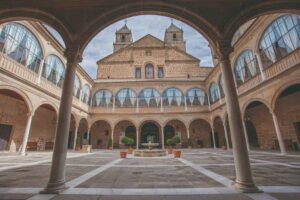
The Hospital de Santiago, that monumental building that the people of Úbeda call their “Sistine Chapel of the Renaissance”, is not exactly a museum, but its temporary exhibition hall deserves a special mention. Throughout the year it hosts exhibitions of contemporary art, photography, sculpture and other disciplines that dialogue with the Renaissance architecture of the building.
In winter, strolling through the spacious rooms of the Hospital de Santiago, admiring its columned courtyard and enjoying a quality exhibition is a pleasure that combines historical heritage and current creation. In addition, the building is usually less crowded than in high season, which allows you to enjoy it more calmly.
Although it is fundamentally a temple, the Sacred Chapel of the Savior also functions as a museum of sacred art. Its interior houses works by Diego de Siloé, Alonso Berruguete and other masters of the Spanish Renaissance. The sacristy, especially, is a jewel with its Plateresque vault and its collection of goldsmiths.
The guided tour explains not only the artistic aspects, but also the historical context of this funerary pantheon ordered to be built by Francisco de los Cobos, secretary of Charles V. Understanding the relationship between political power, economic wealth and artistic patronage helps to understand how the Renaissance Úbeda emerged.
In winter, the light that enters through the stained glass windows creates different effects than at other times of the year, and the interior temperature of the temple, although cool, is more bearable than the outside.
This space, located in a palatial house, recreates domestic environments from the Andalusian period and displays collections of ceramics, textiles, jewellery and other objects of daily use. Although its collection is not as extensive as other museums, its value lies in the ability to evoke what daily life was like in Muslim Úbeda.
The rooms recreate courtyards with fountains, rooms with period furniture and spaces that help to imagine the day-to-day life of a wealthy family in the tenth to the thirteenth centuries. For those looking to understand the city’s deepest roots, this visit perfectly complements that of the Archaeological Museum.
Practical tips for the winter museum route
The museums of Úbeda are perfect to combine in a route of one or two days. Many are concentrated in the historic centre, just a few minutes’ walk from each other, which allows you to design comfortable itineraries without long journeys.
It is advisable to check the opening hours in advance, as some spaces have reduced hours in winter or close on certain days of the week. The tourist office offers combined vouchers that include several museums at a reduced price, an interesting option if you plan to visit more than two or three spaces.
And an important tip: although museums protect from the cold outside, the streets between them are still the same stone cobblestones. Wearing comfortable shoes and keeping warm is still necessary.
Culture that is best enjoyed calmly
The museums of Úbeda are not spaces to visit in a hurry. They deserve time, attention, and a receptive attitude. In winter, when the pace of the city becomes slower and there are fewer visitors, it is possible to enjoy these collections with the tranquility they require.
Each museum tells a part of the history of Úbeda, and the whole makes up a complete account of how this city came to be what it is. To walk through them is to understand not only the past, but also the present of a place that has been able to preserve its memory and project it into the future.