

Experience Úbeda: 3 places that touch the soul in summer
23/08/2025
Hay ciudades que se miran de refilón, como quien ojea un periódico en el café de la esquina. Otras que…

Listen carefully, traveler looking for experiences that justify the effort of traveling: there is a reason why Úbeda is a World Heritage Site, and it does not reside exclusively in its sublime buildings. It lies in something more elusive and powerful: the way in which the most refined architecture of the sixteenth century looks out over an infinite abyss of olive trees that seems to have no end.
With the arrival of March, spring begins to paint the Guadalquivir valley with silvery green that changes hue depending on the time of day and light, making the surroundings of Úbeda the perfect setting for a route that combines the maximum expression of Renaissance culture with the primordial serenity of nature.
Here you don’t choose between architectural heritage or natural landscape. Here both dialogue without words, complement each other effortlessly, create symbiosis that can only be understood by witnessing it.
This is your guide to living that perfect duality at the best time of the year.
If you could only choose one photograph for your blog cover, for your personal album, for your emotional memory, it would be this one. The walk along the Walls of San Millán or the area of the Redonda de Miradores is, in March, an experience that borders on the mystical even for those who do not believe in anything.
From here, the city cuts short – dramatically, almost violently – to make way for the Sea of Olives that stretches as far as the eye can see, and beyond.
What you’ll see with crystal clarity in March:
On clear days (frequent in March), the light is cleaner than in dusty summer or foggy winter. In the background, it allows you to see the peaks of Sierra Mágina, which at this time of year still preserve traces of snow on their highest peaks, creating spectacular chromatic contrast: snowy white + silvery green of the valley + golden ochre of Renaissance stone + intense blue of the spring sky.
Geometry of the landscape: The olive grove does not grow chaotically. It is organized in perfect lines, infinite rows that create hypnotic patterns when the wind sways them simultaneously. It is agriculture turned into involuntary abstract art.
Dizzy depth: You’ll try to calculate how many olive trees you’re seeing simultaneously and give up after losing count at around five thousand. There are millions that surround Úbeda, a plant ocean that has fed generations for millennia.
Go one hour before sunset (in March, approximately 6:00 p.m.-6:30 p.m. depending on the exact day of the month). Arrive in time to choose your corner, to sit in one of the viewpoints, to breathe before the show starts.
What will happen during that magical hour:
18:00-18:30h: The light turns golden but still strong, dyeing the limestone of the towers and walls in honey tones that seem to radiate from within.
18:30-19:00h: The sun goes down on the horizon, the olive grove seems to take on a life of its own under the wind that creates vegetable waves, silvery reflections that move like a liquid but vegetable sea.
19:00-19:30h: The final minutes before the sun disappears. The sky is ablaze with oranges, pinks, purples. The shadows of the olive trees lengthen dramatically. The temperature drops noticeably (he wears a jacket).
7:30 p.m. onwards: The blue hour, that brief moment where everything takes on an almost unreal bluish hue. The lights of the city begin to come on. The landscape is completely transformed.
Don’t leave immediately after sunset. Stay ten minutes longer watching the night gradually take over the valley. It is a transformation that deserves to be witnessed in its entirety.
What to bring:
Check the exact time of sunset according to your specific date of visit.
A few steps from the viewpoints, you will enter what is, by right, one of the most beautiful squares in Europe. The Plaza Vázquez de Molina is a harmonious architectural ensemble that transports you directly to the Italy of the Medici, but with a deeply Jaén soul, with Andalusian light that Italian architecture never had.
Sacred Chapel of the Saviour: Petrified Ambition
Its façade is a visual catalogue of Greco-Roman mythology and Christianity sculpted in stone with obsessive detail. Every inch tells a story, every figure has meaning, every ornament was calculated to impress.
Why it matters:
It is the most ambitious private pantheon of the Spanish Renaissance, commissioned by Francisco de los Cobos – secretary to Charles V, one of the most powerful men in the empire – as a family tomb and demonstration of eternal power.
What you can’t miss inside:
Opening hours: 9:30-14:00 and 16:00-19:00h (varies according to season) Admission: 5€ (minimum investment for maximum experience)
Palace of Chains: proportions that soothe the soul
Today the headquarters of the City Council.
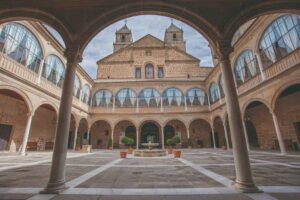
Its interior courtyard is an oasis of peace and perfect proportions. The Renaissance double arcade creates a play of light and shadow that professional photographers love. The geometry of space induces involuntary calm: your breathing slows down, your shoulders relax, your mind quiets.
Other buildings surrounding the square
Basilica of Santa María de los Reales Alcázares: With a mixture of various styles and elevated on an old mosque, sober, with a tower that rises as a spiritual lighthouse.
Palacio del Deán Ortega: Today a national parador, where you can have coffee in its Renaissance patio.
Diverse noble houses: Each façade deserves minutes of detailed observation.
Photo tip: The best light in the square is in the early morning (8-10h) when the sun illuminates the facades from a low angle, or in the afternoon (18-19h) when the golden light does justice to the stone.
Book a guided tour of the square with the tourist service companies of Úbeda
March is a vital month for the tree that literally gives life to this land. After the winter harvest (November-December, which we talk about in our articles on oleotourism), the olive tree begins its new annual cycle: imminent flowering, vegetative growth, promise of future harvest.
The detail that connects landscape with gastronomy
As you walk through the square or the walls, remember that this infinite landscape that you contemplate is the one that supplies the oil for the XXV Gastronomic Days (which end this March 15), for the tables of Úbeda, for export that arrives in Japan, New York, London.
The olive tree is not just contemplative decoration: it is the economic sustenance that allowed these palaces to be built, which financed the Renaissance of Úbeda, which continues to feed the city five hundred years later.
Gastronomic-educational recommendation
Look for an extra virgin olive oil tasting at the Olivar y Aceite Interpretation Centre. The March oil, already rested since the November-December harvest, offers more ripe and balanced notes than the freshly pressed oil of December.
What you will learn in a tasting:
Tasting price: 10-25€ depending on duration and number of oils Duration: 45-90 minutes
Book your EVOO tasting and close the landscape-culture-gastronomy circle.
Unhurried walk: the perfect route that connects everything
The ideal route that integrates all the elements mentioned:
Recommended itinerary (3-4 quiet hours)
Start: Plaza de Andalucía (9:00-9:30h)
Calle Real (9:30-10:30h)
Plaza Vázquez de Molina (10:30-13:00h)
Lunch (13:00-15:00h)
Optional break (15:00-16:30h)
Walls and viewpoints (17:30-19:30h)
Dinner (20:00 onwards)
In March, the average temperature of 17°C makes this walk an absolute delight.
March is the month when Úbeda is kindest to walkers, most generous with those who walk it, most photogenic in every way.
What to pack in your backpack:
Photography Tips for Capturing Duality
Best general light: Early morning (7-10am) and golden afternoon (5pm-7pm)
For the square: Use wide angle to capture full set, telephoto for architectural details
For the olive grove from ramparts: Telephoto helps compress perspective creating a feeling of infinite density
Don’t forget to photograph: Small details (knockers, bars, flowers in patios), local people if they allow (always ask), food you try (EVOO deserves prominence)
Magic Hour for Social Media: Sunset from Walls is Content That Generates Guaranteed Engagement
Between the stone sky carved by Renaissance masters and the sea of olive trees planted by anonymous hands over millennia, Úbeda exists as a perfect balance between culture and nature, between past and present, between contemplation and tasting.
March is the ideal time to experience that duality at its best: spring that awakens the landscape, light that favors photography, temperatures that invite you to walk without haste.
Don’t come to Úbeda just to cross monuments off a list. Come and sit on the walls at sunset understanding that the landscape you contemplate fed the grandeur that surrounds you. Come taste the oil knowing that each bottle contains thousands of olive trees like the ones you just photographed.
Come and live duality. Come and understand the symbiosis. Come to Úbeda in spring.
Share your best captures with #CieloYOlivarÚbeda and be part of the visual community.
The Renaissance awaits you above. The olive grove calls to you from below. Úbeda offers you both without you having to choose.