

Oleotourism in Úbeda: from the ancestral olive tree to your table (passing through the soul)
24/11/2025
Allow me to ask you something, curious traveler: there are territories that produce food, and then there is Úbeda, which…

O noble traveler! Did you think that in Úbeda you would only find golden stones and silent monuments? How naïve you are!
This city, forged in the workshops of the gods of the Renaissance, hides viewpoints that are not mere balconies, but theaters of the soul. Here, each panorama is a verse by Garcilaso, each horizon a brushstroke by Raphael, each sunset a sonata for the eyes.
Be more careful, gentle reader: these viewpoints have the power to turn the most pragmatic bourgeois into a hopeless poet. Don’t say you weren’t warned.
Behind the restored temple – what a beautiful sacrilege to turn the sacred into the cultural! – is hidden this small stage where hearts represent his best work.
Why it seduces: Here the sighs acquire poetic density. Michelangelo would have sculpted his Pietàs del amor here.
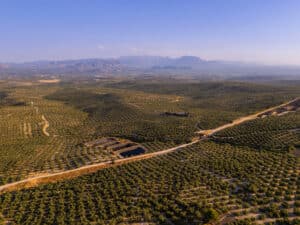
From the Sacred Chapel, a discreet path – like the loves of Lorenzo de’ Medici – leads to the edge of the known universe. The ocean of olive trees that unfolds before you is not landscape: it is green cosmology.
Why it bewitches: Because looking at it you understand that God was also a landscaper. And he had good taste.
On the southern edge of the historic city, next to the remains of the wall, the gaze spills over the ocean of olive trees of La Loma de Úbeda.
Why it captivates: Because you understand that the landscape here is not landscape: it is cultivated eternity.
The plebs are satisfied with the terrace. You, high spirit, ascend one more level. From this celestial loggia, the Renaissance square is revealed as the chessboard where the gods of art played.
Why it dazzles: Because it literally places you between the sky and the masterpiece. Like a Botticelli angel with vertigo.
An ancient entrance to the civitas, this point marks the transition between the everyday profane and the historical sacred . The city ascends in steps, as if it were a scala paradisi of golden stone.
Why it inspires: Every incipit has magic. And this is the prologue to your own Urban Comedy .
There are no selfies or fake poses here. It is the viewpoint of the plain village, where the locals take out their chairs to contemplate the theatrum mundi. You, enlightened outsider, are welcome to this street academy.
Why it integrates: Because it teaches the noblest Renaissance virtue: humanitas. To look from here is to participate in the great human spectacle.
In the confines, where the city bids farewell with elegance, the air becomes drier, the landscape more austere. But there is a refined melancholy that makes it the perfect finale for your urban symphony.
Why it ends: The journey does not end here: it is transfigured. As in the best works of art, the end is also a new beginning.
The viewpoints of Úbeda are not postcards for hurried tourists. They are cathedrals of contemplation, libraries of feeling, academies where the soul learns languages that are not taught in universities.
In each one breathes a different virtù:
And this, gentle reader, does not fit on any smartphone. Although Instagram – that gallery of modern vanities – appreciates it.
📸 Have you made a pilgrimage to any of these visual sanctuaries? Share it with the hashtag #ÚbedaRenacentista and tag @turismodeubeda. We want to contemplate what your cultured eye captured. Because every polite look is a work of art in itself.
When you return to your civitas and some simple soul asks you what you saw in Úbeda, you will not respond with a list of monuments like a vulgar cicerone.
You will say: “I saw light turned into architecture, time crystallized in stone, and the landscape returning my gaze with the complicity of a Renaissance lover.”
And deep down, what you will be confessing is that you contemplated from the educated heart.
Because in Úbeda, even the viewpoints have a soul. And they teach Latin.