

Experience Úbeda: 3 places that touch the soul in summer
23/08/2025
Hay ciudades que se miran de refilón, como quien ojea un periódico en el café de la esquina. Otras que…

There are cities that allow themselves to be photographed.
And then there is Úbeda, which seems to have been designed for it.
Here the light does not fall: it caresses.
Stone does not decorate: it shines.
The streets do not lead: they compose scenes.
Few cities offer such a natural relationship between heritage, light and perspective as this southern Renaissance gem. Every corner has a postcard vocation. Every corner seems to be placed on purpose to force you to take out your cell phone, the camera or simply to stop for a few seconds and think: “this must be remembered”.
So, if you’re looking for the most photogenic places in the city – or simply want to understand why photographers, creators and visual travellers fall in love with Úbeda – here is a route through the corners where the city is best looked at.
Because in Úbeda, beauty does not pose: it lives that naturally.
There are places that don’t need a filter.
The Plaza Vázquez de Molina is one of them.
It is probably the most photographed space in Úbeda. And also one of the most impressive in all of Spain. Surrounded by some of the most important Renaissance buildings in the country, this square is not only monumental: it is scenographic.
Here they live:
The best time to photograph it is early in the morning or late afternoon, when the stone takes on that honey hue that turns any image into a declaration of love for heritage.
If you come to Úbeda with a camera, this is your kilometre zero.
Every monumental city needs a counterpoint.
In Úbeda, that counterpoint is the landscape.
From the Mirador de las Eras del Alcázar, the city opens up to one of its greatest invisible treasures: the immense sea of olive trees that surrounds the region. The contrast between urban monumentality and infinite nature makes this point one of the most special for panoramic photography.
Here the camera captures more than just a view:
captures the territorial dimension of Úbeda, its dialogue with the land, its relationship with the landscape.
Especially recommended:
It’s one of those places where the photo comes out well… even without knowing how to take photos.
The true photogenicity of Úbeda does not live only in its great monuments.
It also dwells in the small.
In the unexpected.
In what appears when you allow yourself to lose yourself.
Because part of the beauty of this city is in its:
The recommendation here is clear: walk aimlessly.
In Úbeda, the best photography is rarely planned.
It is found.
And when it appears, it usually does so in silence, between a shadow cast on old stone and a ray of light entering where you did not expect.
There is another Úbeda that does not show itself at first.
A more intimate one.
More reserved.
More secret.
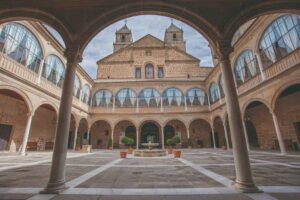
It is that of its interior courtyards, hallways, half-open gates and palaces that hide beauty behind sober facades.
When one of these spaces is accessible to the visitor, entering is like discovering the private scenery of the city.
The courtyards of Úbeda offer:
They are spaces where light bounces in a different way. Softer. More intimate. More cinematic.
No travel photos are taken here.
Here you take photos with soul.
One of the great mistakes of the hurried visitor is to photograph Úbeda only in a wide shot.
Because a good part of its magic is in the detail.
The city’s facades are full of elements that deserve their own photograph:
Úbeda rewards the attentive eye.
The closer you get, the more you discover.
And that turns every ride into a little visual treasure hunt.
When the sun goes down, Úbeda changes register.
The monumental city becomes more dramatic, more elegant, more theatrical.
Night lighting highlights volumes, casts impossible shadows and turns squares and facades into almost cinematic sets.
The best spots for night photography include:
The night reveals a different Úbeda:
less luminous, more emotional.
Less descriptive, more suggestive.
Ideal for those who understand that a good photo doesn’t just show a place: it also conveys a feeling.
If there’s one thing that makes Úbeda a particularly grateful city for photography, it’s how it changes with the seasons.
In spring:
In autumn:
It’s no coincidence that so many photographers choose these stations to capture the city.
Because Úbeda does not always look the same.
And therein lies part of its charm.
There are destinations that are traveled.
Others are photographed.
And then there is Úbeda, which asks for both.
Because this city not only has beautiful corners: it has a structural beauty, an almost scenic harmony between light, architecture, matter and time.
Here each photo tells something more than “I was here”.
He says that you found a place where aesthetics is not ornamentation: it is identity.
So the next time you visit Úbeda, bring your camera… or at least space in the mobile gallery.
You’re going to need it.
Because there are cities that are remembered.
And others that are photographed first… and then they are no longer forgotten.