



Úbeda: World Heritage Site
Úbeda, a World Heritage Site: This Monumental city par excellence, has many remarkable monuments, and more than a hundred buildings of interest. This is a town that has deserved the most varied adjectives: “amazing Úbeda”, “Úbeda Moorish queen”, “demure Úbeda”…. But, above all, Úbeda is an admirable city, incapable of leaving the coldest and most demanding of its visitors unmoved.
It is amazing the set of palaces that reflect the power and wealth of a bourgeoisie and nobility that did not hesitate to count on the most famous architects for the construction of their residences, very much to the taste of the new trends that began to prevail in Italy in the sixteenth century. In this well-finished city, surprise is present at every corner. Unexpectedly, when strolling through the many streets of its historic center, an architectural marvel, the memory of a legend or the simple magic of a popular façade may appear.
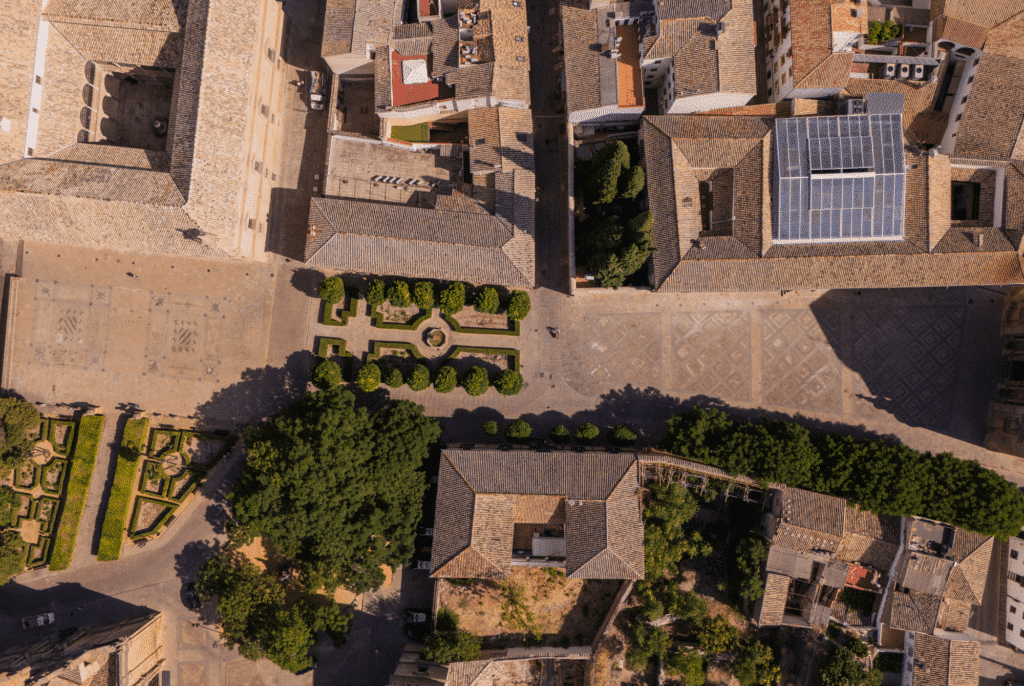
Vázquez de Molina Square
At the southern end of the city stands one of the most beautiful squares in Spain, the Plaza de Vázquez de Molina. Here are some of the most outstanding monuments of the Renaissance: the Sacra Capilla de El Salvador, the Palacio del Deán Ortega, currently the Parador de Turismo; the Palacio del Marqués de Mancera; the Church of Santa María de los Reales Alcázares, with Renaissance facades and Gothic cloister; the Renaissance Fountain, and the Palacio Vázquez de Molina, currently the City Hall.
See more
The Sacred Chapel of El Salvador, a temple of maximum programmatic complexity, stands out. To visit it is, above all, to meet its promoter: Francisco de los Cobos, secretary of Emperor Charles V; Diego de Siloé, author of the general design of the temple; Andrés de Vandelvira, master builder and artist of the Renaissance; Berruguete, author of the ancient altarpiece of the main altar, of which only the grandiose figure of Christ in the transfiguration; with Esteban Jamete, the stone sculptor of the façade and sacristy; with Francisco de Villalpando, author of the superb wrought ironwork, and in short, an encounter with the most ambitious undertaking of all the private religious architecture of the 16th century, a temple that in its day was a symbol of prestige and power and today, an essential key to the enjoyment and knowledge of the Spanish Renaissance.
Around this square there is a succession of streets and stately squares presided over by palaces, churches and convents, such as: The Gothic Church of San Pablo nestled in the delightful Plaza del Mercado or Primero de Mayo, whose interior exhibits an exquisite display of Renaissance grilles; the Convent of San Miguel and the Oratory of San Juan de la Cruz, where the mystic poet died; the Church of the Holy Trinity, of Baroque style, with Renaissance cloister of double porticoed gallery; the Church of San Nicolás de Bari, of Gothic layout, Renaissance grille and front; the Church of San Pedro also Gothic with Renaissance front; the Convent of Santa Clara, one of the most important religious foundations in the city. The Church of San Lorenzo; the Casa de las Torres, a palace with a Castilian accent embroidered with coats of arms, reliefs and symbolic sculptures; the Palace of the Marquis of La Rambla, etc.
Another of the crowning pieces of Renaissance architecture in Úbeda and of the mastery of its author, Andrés de Vandelvira, is the Hospital de Santiago, today converted into the Palacio de Exposiciones y Congresos (Palace of Exhibitions and Congresses). It was ordered to be built by the bishop D. Diego de los Cobos, bishop of Jaén, it is a variation on the traditional hospital of the Catholic Monarchs. In him the sober main facade, preceded by a wide lonja and flanked by two towers, gives way to a harmonious central courtyard from where it distributes its most interesting dependencies. The staircase is decorated with mural paintings, as is the sacristy. The main chapel has an original floor plan, profuse decoration and brilliant grillwork.
Exceptional Universal Value
The Outstanding Universal Value of the Declaration of Úbeda and Baeza is summarized in these two criteria:
- CRITERIA (II)
The examples of 16th century architecture and urban design in Úbeda and Baeza were essential for the introduction of Renaissance ideas in Spain, and, through the treatises that include the constructive innovations of Andrés de Vandelvira, the main architect of these projects, these examples were also disseminated to Latin America. - CRITERION (IV)
The central areas of Úbeda and Baeza are early and outstanding examples of Renaissance civil architecture and urban planning in 16th century Spain.